Sunscreen is the cream that breaks filling machines. A formula that pours like honey in the lab arrives at your filling line at 100,000–250,000 cps, traps air like a sponge, strings off the nozzle, and thickens further while the hopper sits under factory lights. I have specified tube filling lines for cosmetic factories in 30+ countries, and the same six problems appear on almost every high-SPF project — along with the same six fixes.
To fill high-viscosity sunscreen cream reliably, you need four things: a mechanical piston filler with a tail-cutting function, vacuum de-aeration to remove trapped air, a heated double-jacket hopper with stirring for mineral formulas, and hot-air sealing matched to your tube material. Get those four right and ±1% dosing accuracy at 30–50 tubes per minute is achievable — even at 250,000 cps.
Key Takeaways
- Mineral SPF 50 creams commonly reach 100,000–250,000 cps — 20–100× thicker than a body lotion. Standard gravity or peristaltic fillers cannot dose them consistently.
- Air bubbles are a formulation-stability problem, not just a cosmetic one: trapped air oxidizes UV filters and shortens shelf life.
- Nozzle stringing is solved mechanically (tail-cutting), not by slowing the line down.
- A heated jacket hopper with stirring is mandatory for zinc-oxide and titanium-dioxide mineral formulas — they thicken mid-run as temperature drops.
- A purpose-built sunscreen cream tube filling and sealing machine solves all six problems in one frame, from about US$19,500.
About the author — Forester Xiang
Forester combines deep technical knowledge with 20+ years of global market experience. Having personally audited 100+ cosmetic and pharmaceutical factories across 30+ countries, he helps clients buy not just a machine, but a complete, compliant, and profitable packaging solution.
Why Sunscreen Is the Hardest Cream to Fill
Sunscreen is hard to fill because high SPF requires a heavy load of UV filters — especially zinc oxide and titanium dioxide in mineral formulas — which pushes viscosity to 100,000–250,000 cps, far beyond what general-purpose filling equipment is designed to dose. The table below shows where sunscreen sits against other products your line may run:
| Product | Typical Viscosity (cps) | Filling Difficulty |
|---|---|---|
| Water / toner | 1–50 | Easy — gravity or peristaltic |
| Body lotion / shampoo | 2,000–10,000 | Easy — piston or gear pump |
| Chemical (organic) sunscreen | 20,000–80,000 | Moderate — piston filler required |
| Toothpaste / ointment | 50,000–120,000 | Hard — piston + tail-cutting |
| Mineral SPF 50 sunscreen | 100,000–250,000 | Hardest — piston + heating + stirring + de-aeration |
Values are typical industry ranges; always confirm with a viscometer reading of your own formula at filling temperature. The number that matters is viscosity at the hopper, not in the lab — which leads directly to the six problems below.
The 6 Production Problems (and How to Solve Each)
1Inconsistent Dosing on Thick Creams
The fix: a mechanical piston filler. Gravity, peristaltic and gear-pump systems rely on the product flowing; above roughly 50,000 cps sunscreen simply doesn’t flow, it has to be displaced. A mechanical piston pulls a fixed volume on every stroke regardless of viscosity, holding ±1% accuracy. Anything looser than that either gives product away on every tube or risks an under-fill complaint from your retailer.
On factory audits I always ask to weigh ten consecutive tubes off the line. With the wrong dosing system on a thick SPF cream, I’ve seen spreads of ±5% on a 50 ml fill — that is 2.5 ml of free product in every overfilled tube. At one million tubes a year, the “cheaper” filler costs more than the machine did.
2Air Bubbles Trapped in the Cream
The fix: vacuum de-aeration before the nozzle, plus bottom-up filling. Thick creams hold air like a sponge — it gets whipped in during mixing and transfer and cannot escape on its own. Trapped air causes visible voids, under-weight tubes, and a real chemistry problem: oxygen degrades organic UV filters such as avobenzone, shortening shelf life. De-aerate the cream, then fill from the bottom of the tube upward as the nozzle retracts, so no new air is folded in.
3Stringing and Nozzle Drip
The fix: a mechanical tail-cutting function, not a slower line. High-viscosity creams form a string between the nozzle and the filled tube; the string falls into the seal area and contaminates it. Slowing the machine down only reduces output — the string still forms. A tail-cut (shut-off) nozzle mechanically severs the product column at the end of each stroke, leaving a clean break and a clean seal zone.
The most common “sealing problem” I am asked to troubleshoot is not a sealing problem at all. When a customer sends me photos of leaking tubes, the first thing I look for is cream smeared inside the tube end — nine times out of ten the root cause is stringing at the nozzle, two stations earlier.
4Mineral Formulas That Thicken Mid-Run
The fix: a heated double-jacket hopper with a stirring device. Zinc-oxide and titanium-dioxide formulas are shear-thinning and temperature-sensitive: they leave your mixing tank pumpable, then thicken in the hopper as they cool and sit still. The result is morning batches that fill perfectly and afternoon batches that clog. A water-circulation jacket holds the cream at a set temperature and a slow stirrer keeps pigment particles suspended, so tube number 20,000 fills exactly like tube number 1.
5Leaking Seals on Filled Tubes
The fix: hot-air sealing with a clean seal zone. For PE and ABL/PBL laminated tubes, hot air heats the inside of the tube end to melting point before the jaws close, producing a hermetic weld through any minor residue — a Swiss LEISTER generator gives the temperature stability this needs. Combined with the tail-cutting fix in problem 3, leak rates drop to effectively zero. For a deeper comparison of sealing technologies, see our guide to cosmetic tube filling sealing machines.
6Product Waste at Cleaning and Changeover
The fix: 316L dead-corner-free contact parts and quick-change molds. A hopper and pump with crevices can trap hundreds of grams of cream per cleaning cycle — sunscreen actives are among the most expensive raw materials in cosmetics, and high-viscosity cream does not rinse out of corners. Mirror-polished 316L stainless contact parts with no dead corners cut both product loss and cleaning time, and dedicated quick-change mold sets keep SKU changeover under 30 minutes.
Buyers compare machines on speed, but in a real cosmetics plant the line spends 10–15% of its hours in cleaning and changeover. When I configure a line, I ask about SKU count before I ask about tubes per minute — a brand running five tube sizes needs fast molds far more than it needs five extra tubes a minute.
What Equipment Do You Actually Need?
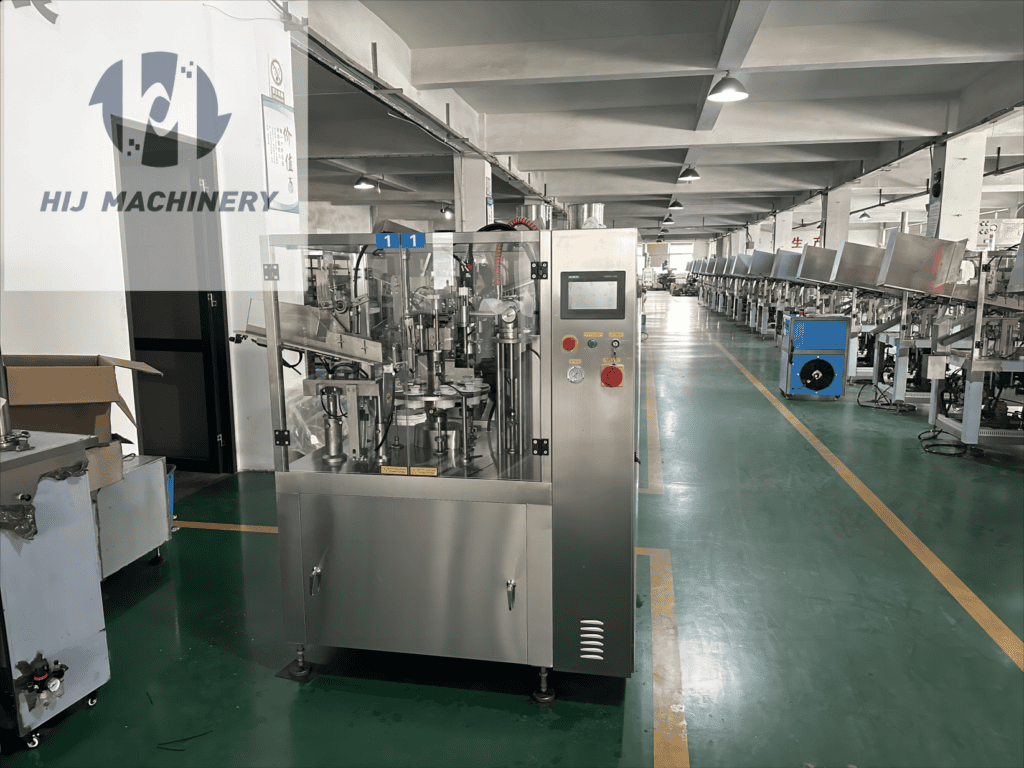
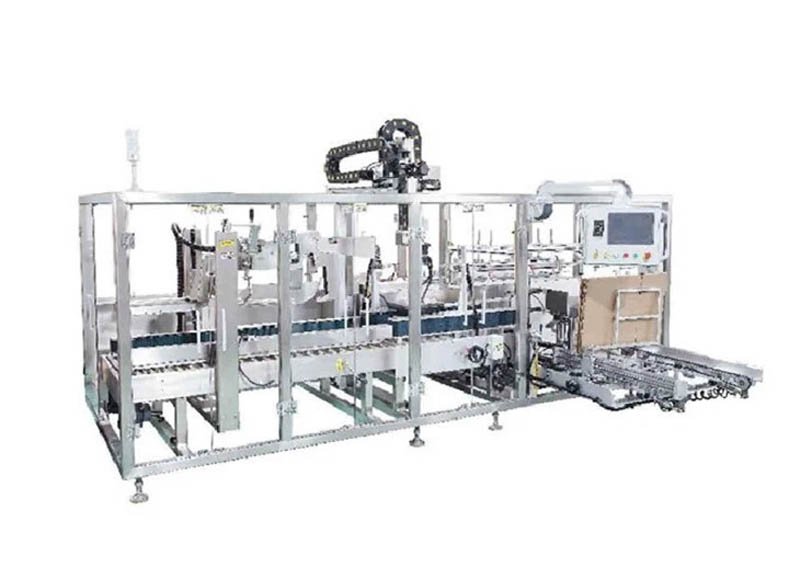
All six fixes above can live in a single machine frame. They are the exact design brief behind the HIJ TF-60 sunscreen cream tube filling and sealing machine:
HIJ TF-60 — built for the six problems
- Problem 1: mechanical piston filler, ±1% at up to 250,000 cps
- Problems 2–3: de-aeration-ready dosing with tail-cutting nozzle
- Problem 4: optional heated double-jacket hopper + stirrer
- Problem 5: Swiss LEISTER hot-air sealing for PE and ABL/PBL tubes
- Problem 6: 316L dead-corner-free contact parts, quick-change molds
- 30–50 tubes/min, 5–250 ml, from about US$19,500 FOB
Scaling beyond one filler? See how it integrates into a complete automatic cosmetic filling line, or compare budgets across machine types in our cosmetic packaging machine price guide. Filling jars or bottles as well? You’ll want a cream filling machine alongside the tube line.
Frequently Asked Questions
What viscosity is sunscreen cream?
Chemical (organic-filter) sunscreens typically measure 20,000–80,000 cps, while mineral SPF 50 formulas with zinc oxide or titanium dioxide commonly reach 100,000–250,000 cps. Always measure your own formula with a viscometer at the actual filling temperature, since viscosity changes significantly as the cream cools.
What type of filling machine is best for thick cream?
A mechanical piston filler is the best choice for creams above roughly 50,000 cps, because it displaces a fixed volume on every stroke regardless of how the product flows, holding ±1% accuracy. Gravity, peristaltic and gear-pump fillers all depend on the product flowing freely and lose accuracy on thick creams. A sunscreen tube filling and sealing machine combines the piston filler with tail-cutting and hot-air sealing in one frame.
How do you remove air bubbles when filling cream?
Air bubbles are removed in two stages: vacuum de-aeration of the cream before it reaches the filling nozzle, and bottom-up filling where the nozzle starts at the bottom of the tube and retracts as it fills, so no new air is folded into the product. De-aeration also protects shelf life, because trapped oxygen degrades organic UV filters.
Can one machine fill both chemical and mineral sunscreen?
Yes. A piston-filler machine handles both formula types; the key option for mineral sunscreen is a heated double-jacket hopper with a stirring device, which keeps zinc-oxide and titanium-dioxide formulas at constant temperature and homogeneity so they do not thicken or separate mid-run. With that option fitted, switching between chemical and mineral SKUs is a normal changeover.
How fast can sunscreen tubes be filled and sealed?
A single-head automatic machine such as the HIJ TF-60 fills and seals 30–50 tubes per minute depending on fill volume and viscosity — roughly 21,000–24,000 tubes per 8-hour shift at a typical 50 ml fill. Higher outputs are reached by running machines in parallel within an automatic filling line.
Not Sure Which Configuration Your Formula Needs?
Send me your formula type, viscosity reading and target output. I’ll tell you honestly whether you need the heated hopper, the plunger pump — or neither. No obligation.
Get a Free Technical Assessment