FDA Requirements for Cosmetic Packaging Machines: What US-Bound Brands Must Know
The FDA doesn’t “approve” machines — it regulates the product they make. Here’s what that really means for your line.
The Short Answer
There is no such thing as an “FDA-approved” cosmetic packaging machine. What matters is the product the machine produces:
- The FDA regulates the product, not the equipment — your cosmetic must not be adulterated or misbranded under the FD&C Act.
- MoCRA changed the landscape — facility registration, product listing, adverse-event records, safety substantiation, and forthcoming cosmetic GMP rules.
- Inspectors look at outcomes — accurate fill, sanitary contact surfaces, lot/batch coding, traceability, and the records that prove it.
- Don’t chase a certificate that doesn’t exist — build a line that produces a clean, accurate, fully traceable product.
Myth vs Fact
Myth: “I need FDA-approved or FDA-certified packaging equipment to sell cosmetics in the US.” Fact: The FDA does not approve, certify or register cosmetic packaging machines. It regulates the finished cosmetic product — requiring that it is not adulterated or misbranded — and, under MoCRA, regulates the facility and manufacturer. Your equipment matters because of the product outcomes and records it enables, not because of any certificate on the machine.
For brands shipping cosmetics into the United States, FDA compliance is one of the most misunderstood topics in packaging. Founders spend weeks hunting for “FDA-approved fillers” that don’t exist, while overlooking the things US inspectors actually examine. This guide clears up the confusion: what the FDA truly regulates, how the Modernization of Cosmetics Regulation Act (MoCRA) reshaped the rules, and exactly which equipment features keep a US-bound line clean, accurate and inspection-ready.
Don’t chase a certificate — build a line that produces a clean, accurate, traceable product
Many brands assume the FDA “approves” cosmetic machines the way it does medical devices — it doesn’t. There’s no equipment certification stamp waiting at the border. What the FDA actually cares about is the outcome your machine produces: a product that isn’t adulterated, is filled accurately, is traceable, and is made under sanitary conditions. With MoCRA now reshaping the landscape — facility registration, product listing, adverse-event tracking — your packaging line becomes part of a documentation chain that has to hold up to scrutiny, even though the machine itself is never “FDA-approved.” I’ve watched US-bound brands fixate on finding “FDA-certified” equipment that doesn’t exist, while overlooking the things regulators truly inspect: fill accuracy, lot coding, sanitary contact surfaces, and the records that prove it.
Does the FDA “approve” cosmetic packaging machines?
No. This is the single most important thing to understand. Unlike medical devices or drugs, cosmetics and the equipment used to make them are not subject to FDA pre-market approval. There is no FDA certificate for a filler, capper, labeler or tube sealer, and no machine you can buy that is “FDA-approved” for cosmetics. Any vendor claiming to sell “FDA-approved cosmetic packaging machines” is, at best, using the phrase loosely.
What the FDA does have is authority over the finished cosmetic product under the Federal Food, Drug, and Cosmetic Act (FD&C Act), and — since 2022 — broader authority over cosmetic facilities and manufacturers under MoCRA. The machine enters the picture only through the product it makes and the conditions under which it operates. Reframe the question from “Is my machine FDA-approved?” to “Does my machine help me produce a product that is not adulterated, accurately filled, sanitary and fully traceable?” — and you’re finally asking the right thing.
What the FDA actually regulates: adulteration and misbranding
Under the FD&C Act, the two cardinal sins for a cosmetic are being adulterated or misbranded — and your equipment can cause both.
A cosmetic is broadly considered adulterated if it contains a harmful or filthy substance, or if it was prepared, packed or held under insanitary conditions where it may have become contaminated. This is where packaging equipment matters directly: a filler with non-sanitary contact surfaces, product traps that breed microbes, or inadequate cleaning between batches can render a product adulterated regardless of how good the formula is.
A cosmetic is misbranded if its labeling is false or misleading, or if required information (such as net quantity of contents) is missing or inaccurate. This is where fill accuracy and coding come in: if your filler can’t reliably deliver the labeled net contents, or your line can’t apply accurate lot codes and required label information, you risk a misbranding problem.
Where the line meets the label: net contents and required information
US cosmetic labeling rules deserve their own attention because several of them depend directly on what your packaging line does. The label must carry an accurate net quantity of contents, an ingredient declaration, and the name and place of business of the manufacturer, packer or distributor — and any required warnings. Your equipment intersects this in two concrete ways.
First, the fill must actually match the declared net contents. If your line systematically under-fills against the label, that’s not merely wasted goodwill — it’s a misbranding exposure, because the stated quantity is no longer truthful. A filler that holds its tolerance across temperature and viscosity swings keeps your net-contents claim honest run after run. Second, the coding and labeling stations must apply the correct, legible, durable information to the right unit. A smeared lot code or a mis-registered label on a decorated tube isn’t a cosmetic flaw — it can undermine traceability and the completeness of required labeling.
The takeaway is that “labeling compliance” isn’t only a graphic-design or regulatory-affairs task; it’s partly an equipment capability. When you specify a line for the US, treat accurate fill, reliable coding and clean label application as compliance features, not just quality ones. The same hygienic, accurate, well-documented cosmetic packaging machines that protect against adulteration also protect against misbranding.
How MoCRA reshaped the US cosmetic landscape
The Modernization of Cosmetics Regulation Act of 2022 (MoCRA) was the most significant expansion of FDA authority over cosmetics in decades. It doesn’t create an “approved machine” list, but it does build a documentation and accountability chain that your equipment and records must support. The headline provisions:
- Facility registration — manufacturing and processing facilities must register with the FDA and renew periodically.
- Product listing — cosmetic products and their ingredients must be listed with the FDA.
- Adverse event recordkeeping & reporting — responsible persons must keep records of, and report, serious adverse events.
- Safety substantiation — brands must hold records substantiating the safety of their products.
- Good Manufacturing Practice (GMP) rulemaking — MoCRA directs the FDA to establish cosmetic GMP regulations, moving US practice closer to a formal GMP framework.
- Mandatory recall authority — the FDA can order recalls of cosmetics it deems a hazard.
The practical effect for your packaging line: as the FDA develops cosmetic GMP regulations and exercises recall authority, the ability to trace a product back through lot codes and production records becomes essential. A line that can’t tell you which batch went into which case is a liability in a recall. This is why traceability — not a mythical certificate — is the real FDA-readiness feature.
What FDA inspectors actually look at on your line
When the FDA inspects a cosmetic operation, it isn’t checking machines for certificates — it’s looking for evidence that products are made under sanitary, controlled, traceable conditions. The equipment-related things that matter:
| “FDA-approved machine” (the myth) | What actually matters (the reality) |
|---|---|
| A certificate stamped on the machine | Sanitary, cleanable contact surfaces that don’t contaminate product |
| An “FDA-registered” filler model | Accurate, repeatable fill matching labeled net contents |
| A border approval for equipment | Reliable lot/batch coding for traceability and recall |
| A one-time inspection pass | Documented cleaning, maintenance and production records |
| Buying the “right brand” of machine | A facility and process that produce an unadulterated, correctly labeled product |
In other words, FDA-readiness is an outcome of how your line is designed and documented, not a label on a box. Four equipment capabilities do most of the work: sanitary design, fill accuracy, coding/traceability, and record-keeping.
It’s worth understanding how an inspection actually unfolds, because it reframes what “readiness” means. An FDA investigator typically observes the operation, examines the facility and equipment for sanitary conditions, and — crucially — asks to see records: cleaning logs, batch records, complaint and adverse-event files, and the documentation that ties a finished lot back to its inputs. They are testing whether your stated procedures match reality and whether you can prove control. A spotless machine with no records is weak; a well-documented line that can immediately produce its cleaning history and trace a lot is strong. This is why the controller and record-keeping capabilities of your equipment matter as much as the stainless steel — the machine that captures evidence automatically makes the inspection a non-event, while a line that relies on memory and loose paper invites findings.
Equipment features that keep a US-bound line inspection-ready
1. Sanitary contact surfaces and cleanability
Because “insanitary conditions” can render a product adulterated, hygienic design is your first line of defense. Specify food/cosmetic-grade contact surfaces (commonly 316L stainless steel), smooth finishes, no dead-legs, drainable product paths, and quick dismantling or clean-in-place capability. These are the same principles that underpin ISO 22716 cosmetic GMP, which is why a GMP-ready machine is also a strong foundation for US compliance.
2. Accurate, repeatable fill
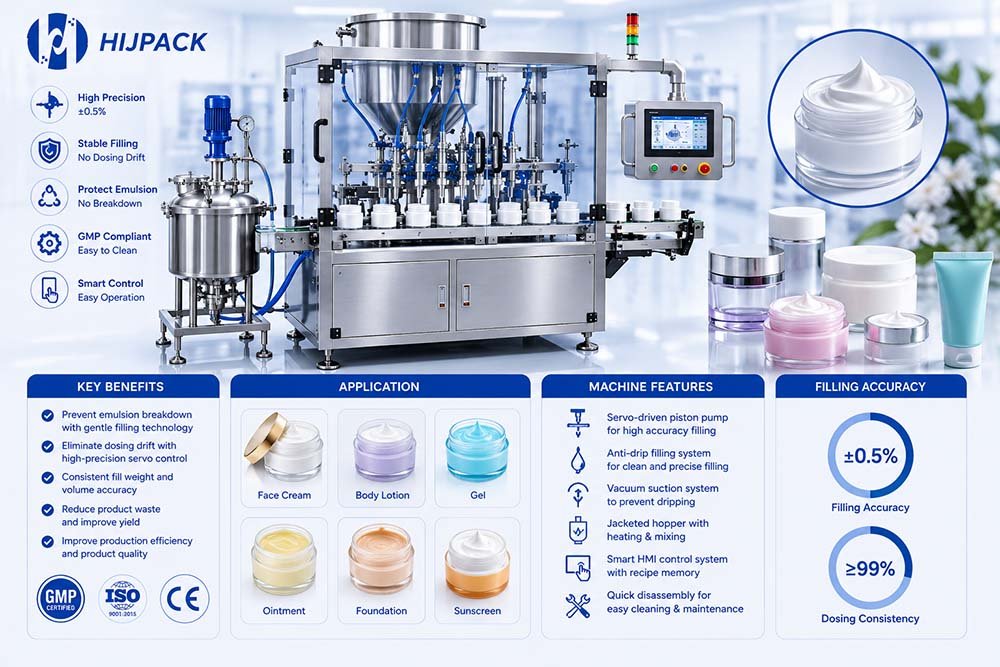
Net-contents accuracy isn’t just quality control — under-filling against a labeled quantity is a misbranding risk. Choose a filler that holds a tight tolerance across your product’s viscosity range, ideally with servo control and optional check-weighing. Match the dosing technology to the product, as covered in our cream vs lotion vs serum filling guide, and explore the dedicated cream filling machine for thicker products.
3. Lot coding and traceability
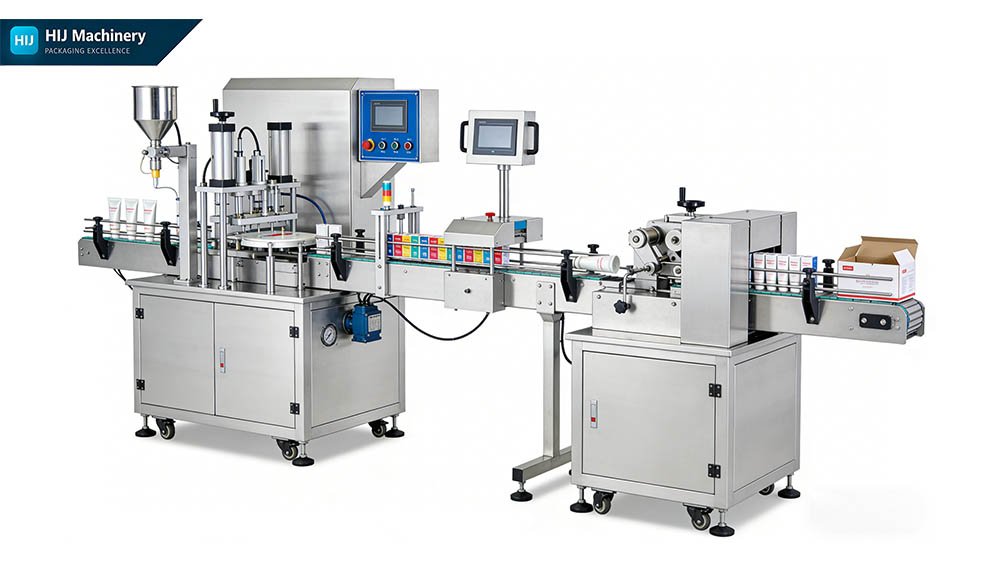
Reliable batch/lot coding is the backbone of recall readiness under MoCRA. An inline coder that applies legible lot numbers and dates, integrated with production records, lets you trace any unit back to its batch. For tube products, coding is typically built into the cosmetic tube filling and sealing machine sequence.
4. Records and documentation
Inspectors read records, not minds. A controller that logs batch parameters, stores recipes, restricts unauthorized changes, and supports cleaning and maintenance logs turns FDA-readiness into routine evidence. This documentation chain is what actually survives an inspection.
Shipping cosmetics into the US market?
Tell us your products and volumes — our engineers will spec a sanitary, accurate, fully traceable line built for US-bound production and inspection-readiness.
FDA (US) vs ISO 22716 (EU): how they compare
Brands selling into both the US and EU often ask how the two regimes relate. They share the same underlying goal — safe, properly made, accurately labeled cosmetics — but frame it differently.
| Aspect | FDA (US) | EU (ISO 22716) |
|---|---|---|
| Core mechanism | FD&C Act + MoCRA | Cosmetics Regulation 1223/2009 + ISO 22716 GMP |
| Equipment “approval” | None — product/facility focus | None — GMP applies to how product is made |
| GMP | Formal GMP rules in development under MoCRA | ISO 22716 GMP already the recognised standard |
| Registration | Facility registration + product listing (MoCRA) | Responsible person + product notification (CPNP) |
| What helps both | Hygienic, cleanable equipment; accurate fill; lot coding; documented records | |
The good news: a machine built to satisfy ISO 22716 hygienic-design and documentation principles is already most of the way to US readiness. Build once for both markets. For the EU side in detail, see our ISO 22716 equipment guide.
FDA-readiness checklist for US-bound brands
Work through this when specifying or auditing a line for US-bound cosmetics:
- Product-contact surfaces are sanitary, cleanable and non-reactive (typically 316L stainless steel).
- Product paths are drainable with no dead-legs, and the machine can be cleaned and verified clean.
- The filler holds accurate net contents across your product’s viscosity range.
- An inline coder applies legible lot numbers and dates, linked to production records.
- The control system logs batch parameters and restricts unauthorized changes.
- Cleaning, maintenance and production records are documented and retrievable.
- Your facility is registered and your products listed with the FDA (MoCRA), with current deadlines verified.
- You hold safety substantiation and adverse-event records as required.
- You can trace any finished unit back to its batch for recall readiness.
Frequently asked questions
Is there such a thing as an FDA-approved cosmetic packaging machine?
No. The FDA does not approve, certify or register cosmetic packaging machines. Unlike drugs and medical devices, cosmetics and their manufacturing equipment are not subject to FDA pre-market approval. The FDA regulates the finished product (it must not be adulterated or misbranded) and, under MoCRA, the facility and manufacturer. Any claim that a machine is “FDA-approved” for cosmetics should be treated with caution.
What does the FDA actually require to sell cosmetics in the US?
At a high level: the product must not be adulterated (no harmful or filthy substances, made under sanitary conditions) or misbranded (truthful, complete labeling including accurate net contents). Under MoCRA, manufacturing facilities must register, products must be listed, and brands must keep safety substantiation and adverse-event records. Always confirm current MoCRA deadlines with the FDA or counsel.
What is MoCRA and how does it affect my packaging line?
The Modernization of Cosmetics Regulation Act of 2022 expanded FDA authority over cosmetics, introducing facility registration, product listing, adverse-event recordkeeping, safety substantiation, mandatory recall authority, and a mandate for the FDA to set cosmetic GMP regulations. For your line, the key impact is traceability and documentation: you must be able to trace products by lot for recall readiness and operate under increasingly formal GMP expectations.
How does the FDA inspect cosmetic equipment?
The FDA doesn’t check machines for certificates. It looks for evidence that products are made under sanitary, controlled, traceable conditions: sanitary contact surfaces, effective cleaning, accurate fill matching labeled contents, reliable lot coding, and documented cleaning, maintenance and production records. FDA-readiness is an outcome of how the line is designed and documented.
If my equipment meets ISO 22716, is it ready for the US?
Largely, yes, on the equipment side. ISO 22716 hygienic-design and documentation principles — cleanable 316L surfaces, drainable paths, calibration, records — align closely with what the FDA expects for sanitary, traceable production. You still need to handle US-specific obligations like MoCRA facility registration, product listing and labeling rules, but the machine built for ISO 22716 is a strong foundation for both markets.
What’s the most common FDA misconception among new brands?
Searching for “FDA-approved” or “FDA-certified” equipment that doesn’t exist, while overlooking what regulators truly examine: fill accuracy, sanitary contact surfaces, lot coding and the records that prove it. The right focus is building a line that produces a clean, accurate, fully traceable product, because that is what clears customs and survives an inspection.
Three FDA misconceptions that cost US-bound brands
The same misunderstandings trip up brand after brand. Naming them is the fastest way to avoid wasting money and time:
- “I need to find FDA-approved equipment.” It doesn’t exist for cosmetics. Time spent searching for it is time not spent specifying sanitary design, accurate fill and traceability — the things that actually matter. Redirect the energy.
- “Compliance is a one-time event at purchase or import.” It isn’t. Under MoCRA, registration renews, records must be kept current, and recall readiness is ongoing. Your line has to keep producing traceable evidence, not pass a single checkpoint.
- “Labeling is just a design and regulatory task.” Partly true, but net-contents accuracy and durable, legible coding are produced by your machines. A beautifully designed label on an under-filled or mis-coded unit is still a compliance problem.
Each misconception shares a root cause: thinking of FDA compliance as a stamp rather than a system. Reframe it as “produce a clean, accurate, traceable product and prove it,” and your equipment decisions line up naturally with what regulators actually want. It’s the same outcome-first mindset that underpins our cosmetic packaging machine buyer’s guide.
Build for the outcome, not the certificate
The FDA will never hand your filler a certificate, because that’s not how cosmetics are regulated in the US. What it will do is hold your finished product to account: it must be unadulterated, accurately filled, properly labeled and — increasingly under MoCRA — fully traceable and made under documented, GMP-aligned conditions. Brands that understand this stop hunting for mythical “FDA-approved” machines and start specifying the features that actually matter: sanitary design, accurate fill, reliable coding and solid records. Build a line around those, and US compliance becomes a byproduct of good engineering rather than a scramble at the border.
When you’re ready to specify a US-bound line, explore cosmetic packaging machines for the USA, the full range of cosmetic packaging machines, or talk to an engineer about a sanitary, traceable turnkey solution.