To choose a case sealing machine, verify twelve things in this order: carton size envelope, carton weight vs drive system, throughput with headroom, changeover speed, tape compatibility, utilities, frame build, safety features, integration path, supplier type, spare parts, and documentation. The two specs that eliminate the most machines fastest are the size envelope (your largest carton must fit — e.g. L 200–600 mm on the HIJ-600) and the drive system (heavy or tall cartons need a top-and-bottom belt drive, not side belts).
A case sealer is the cheapest machine on your end-of-line — which is exactly why buyers under-specify it, pick from a price list, and end up with skewed tape, slipping boxes, or a machine that can’t take next year’s carton. The good news: this is a mechanically mature category, and twelve checks are enough to get the purchase right the first time.
Work through the checklist below with your own carton data in hand. If you need the category fundamentals first, read what a case sealing machine is; the machine used as the reference example throughout is the HIJ-600 automatic case sealing machine, part of the full case packing machine range.
The 12-Point Checklist
1Carton size envelope
Measure your smallest and largest cartons — including any planned for next year — and confirm both fit the machine’s stated range. The HIJ-600 covers L 200–600 × W 160–500 × H 200–600 mm. A carton outside the envelope isn’t a small problem; it’s a second machine.
2Carton weight vs drive system
Spec the machine around your heaviest carton, not your average one. Side-belt drives slip on heavy or tall boxes; a top-and-bottom belt drive grips the full carton weight and keeps tape centered. This single line item explains most of the price difference between two otherwise similar quotes — the mechanics are covered in our working principle guide.
3Throughput with headroom
Take your peak (not average) boxes-per-hour and add 30% headroom. The HIJ-600’s 720 boxes/hour rating comfortably covers lines shipping several thousand boxes per shift. If cartons will arrive by conveyor from an automated packer, revisit the semi-vs-fully-automatic question in our dedicated comparison.
4Changeover speed
Count how many carton sizes you run per day. Batches of a few sizes → hand-wheel changeover (under one minute on the HIJ-600) is ideal. Every consecutive box different → you need a random sealer, and no uniform machine will save you.
5Tape compatibility
Confirm the taping heads accept your tape width — 48/60/72 mm are the standards — and that heads are removable for bench maintenance. If you use printed branded tape, verify roll diameter and core size compatibility too.
6Utilities and footprint
Check power (single-phase 220V on the HIJ-600 — no electrical work needed in most facilities), compressed air requirement (50 L/min), floor space (1830 × 835 mm), and working height match with your existing conveyors. Casters are worth insisting on.
7Frame and build quality
A welded steel frame stays rigid at speed; bolted light frames vibrate and drift out of square. For washdown or food-adjacent environments, ask about stainless construction. Ask the supplier for a video of the machine sealing a heavy carton at full speed — frame flex is visible.
8Safety features
Minimum: guarded taping-head blades, an accessible emergency stop, and finger protection at belt entry points. CE-marked configurations document these; ask for the certificate scope in writing.
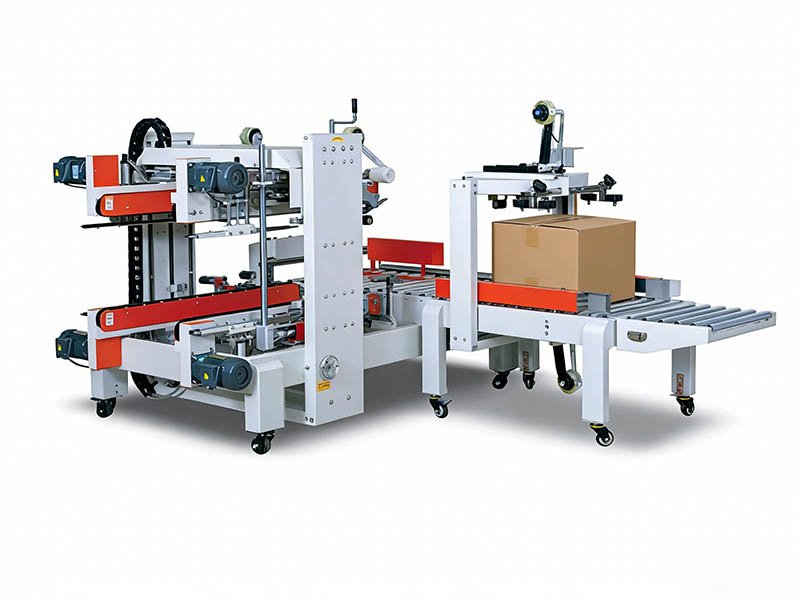
Checklist point 9 in practice: export cartons often need corner reinforcement beyond the center seal.
9Integration and upgrade path
Will this sealer ever sit inline? Confirm conveyor heights and speed matching now. If your cartons ship as heavy export cases, plan for a four corner sealing machine downstream; if full automation is on the roadmap, check the supplier also builds case packers and all-in-one systems so the machines are designed to connect — the sequencing logic is in our end-of-line guide.
10Supplier type
Manufacturer-direct beats trading company: you remove a 15–25% margin and gain direct access to the engineers who built the machine. Verify the factory exists — ask for a live video call from the workshop floor with your machine type in frame.
11Spare parts and support
Order the wear-parts kit (blades, belts, springs, rollers) with the machine. Confirm response time for remote support and whether commissioning is documented in video — details of HIJ’s coverage are under service & support.
12Documentation
A serious supplier provides a full datasheet, electrical schematic, layout drawing, and operation manual in English before you pay — and a pre-shipment test video of the machine sealing cartons matching your specifications. Treat missing documentation as a red flag, not an inconvenience.
Budget Reality Check
With the twelve points scored, price the shortlist properly: semi-automatic uniform sealers, random sealers, and fully automatic machines occupy very different brackets, and the landed cost includes freight, duties, and the spare-parts kit. Full 2026 figures by machine type are in our case sealing machine price guide. For multi-machine projects, quoting the line as a single turnkey solution is usually cheaper than the sum of separate purchases once integration labor is counted.
Three Red Flags That End the Conversation
1. No carton questions asked. A supplier who quotes without asking your carton sizes and weights is selling from a price list, not engineering a solution.
2. “It handles any box.” No sealer does. Every machine has a size envelope and a weight limit; a supplier who won’t state them is hiding them.
3. No pre-shipment video. If they won’t film the machine sealing cartons like yours before shipping, assume it hasn’t been tested with cartons like yours.
“My checklist for buyers fits in one sentence: send the supplier your three worst cartons — the heaviest, the tallest, and the flimsiest — and ask for a video of their machine sealing all three. Specification sheets describe the machine at its best; those three cartons show you the machine at your worst. Any factory confident in its build will send that video within a week.”
Key Takeaways
- Twelve checks cover the purchase: size envelope, drive system, throughput, changeover, tape, utilities, frame, safety, integration, supplier, spares, documentation.
- Size envelope and drive system eliminate the most machines fastest — spec around your largest and heaviest carton, never the average.
- Add 30% throughput headroom over your peak; the HIJ-600’s 720 boxes/hour covers most SME lines with room to grow.
- Buy manufacturer-direct, order the wear-parts kit with the machine, and demand full documentation before payment.
- The pre-shipment test video with your own carton specs is the single strongest acceptance tool available to a remote buyer.
- Red flags: no carton questions, “handles any box” claims, and refusal to film a pre-shipment test.
Put the Checklist to Work — Send Us Your Three Worst Cartons
Share your carton dimensions, weights, and daily output. We’ll confirm the right configuration, film a test, and send a formal quotation within 24 hours.
Get Free Turnkey QuoteFrequently Asked Questions
What is the most important specification when choosing a case sealer?
How much throughput headroom should I specify?
Should I buy from a manufacturer or a trading company?
What documents should the supplier provide before I pay?
Do I need corner sealing as well as a standard case sealer?
About HIJ Machinery
HIJ Machinery (legal name: Wenzhou Trustar Machinery Technology Co., Ltd), founded in 2004 in Rui’an, Wenzhou, Zhejiang, China, manufactures pharmaceutical, cosmetic, and food packaging machinery — including blister packing machines, cartoning machines, capsule filling machines, and case packing machines such as the HIJ-600 automatic case sealing machine. Equipment is CE-marked, manufactured under the ISO 9001 standard, and built cGMP-ready, with installations in more than 30 countries.
This article was written and technically reviewed by Forester Xiang, founder and chief engineer of HIJ Machinery, with 20+ years of packaging engineering experience and more than 100 pharmaceutical facility audits worldwide. Contact our engineering team for equipment selection support.