Get Quote
How to Choose a Liquid Filling & Sealing Machine

About Forester

As the founder of HIJ Machinery (Wenzhou) and a former R&D engineer, Forester Xiang combines deep technical knowledge with 20+ years of global market experience. Having personally audited 100+ pharmaceutical factories across 30+ countries, he provides clients not just a machine, but a complete, compliant, profitable pharmaceutical packaging solution.

Buying the wrong filling machine is an expensive mistake — too few heads and you can’t meet orders; the wrong dosing system and your product foams, drips, or gives away margin on every shot. After specifying lines for factories in 30+ countries, I’ve found the buyers who get it right all follow the same order of questions. Here is that 7-step framework, so you choose by fit, not by the cheapest spec sheet.

About the author — Forester Xiang

Founder & former R&D Engineer, HIJ Machinery (Wenzhou)

Forester combines deep technical knowledge with 20+ years of global market experience. Having personally audited 100+ pharmaceutical factories across 30+ countries, he helps clients buy not just a machine, but a complete, compliant, and profitable packaging solution.

How to choose a liquid filling & sealing machine

Choose a liquid filling & sealing machine by answering seven questions in order: your product, your container, your output, your sterility needs, your accuracy needs, your true cost of ownership, and your supplier. Get the order right — product first, price last — and the correct machine type, head count, and build grade fall out naturally.

The order that matters

Product → Container/dose format → Output → Sterility & compliance → Accuracy → Total cost of ownership → Supplier. Most costly mistakes come from starting at price instead of product.
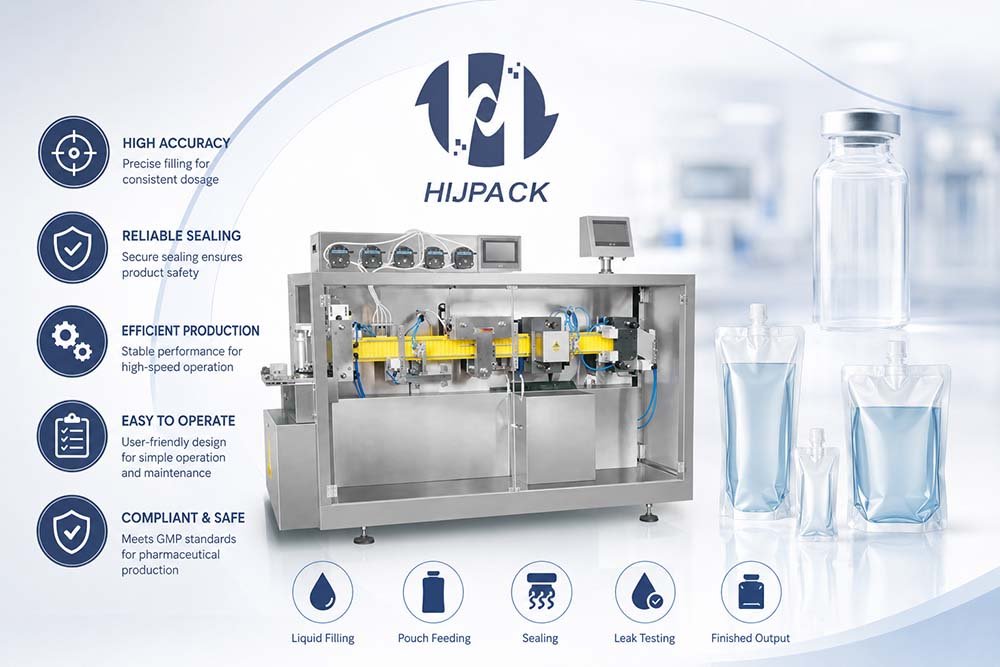
Choosing a liquid filling and sealing machine line
The right machine is the one that fits your product, dose format, and real output — not just the lowest quote.
1

Start with your product

Viscosity, foaming, particulates, volatility, and temperature decide the dosing technology: piston for viscous or chunky liquids, flow-meter for free-flowing, peristaltic for sterile or shear-sensitive, gear pump for honey-thick products. A volatile, alcohol-based fragrance and a thick sauce need very different machines — define the product before anything else.

2

Define your container and dose format

Single-dose or multi-dose? Ampoule, bottle, vial, sachet, or tube? Fill volume range? This sets the machine type. Single-dose plastic ampoules point to a liquid filling sealing machine built on blow-fill-seal; bottles point to a filler-plus-capper; sticky single-serves point to a sachet or tube machine.

3

Set a realistic output target

Your honest containers-per-minute target decides head count and automation level — manual, semi-automatic, or fully automatic. Buy for the next 2–3 years of demand, not a fantasy peak you’ll never hit.

4

Confirm sterility and compliance needs

Sterile pharma needs WHO-GMP build and often a Class 100 (ISO 5) clean zone; food needs 3-A sanitary and CIP; cosmetics align with ISO 22716. These requirements change the quote more than head count does — settle them early.

5

Decide your accuracy tolerance

Expensive products justify servo dosing at ±0.5–1% to cut giveaway; tight tolerances also matter for dose-critical pharma. Cheap products can accept wider tolerance and a simpler filler.

6

Compare total cost of ownership, not sticker price

Factor labor saved, product giveaway, uptime, changeover time, spares, and support — not just the purchase price. A higher-spec automatic machine often has a lower cost per unit produced. See our ampoule filling machine price & ROI guide.

7

Vet the supplier as hard as the machine

Documentation, a real Factory Acceptance Test (FAT), validation support (IQ/OQ/PQ), spare-parts access, and responsive after-sales separate a good investment from a cheap regret. Ask for references in your industry and country.

Quick selection matrix: product → machine

A fast starting point. Your exact configuration still depends on output and compliance, but this maps the most common needs to the right machine:

If you’re filling…Look at…
Single-dose oral liquid / eye dropsPlastic ampoule fill-seal (BFS) machine
Monodose serum / essence ampoulesCosmetic ampoule filling machine
Perfume / essential oil (volatile)Perfume & essential oil filling machine
Honey / syrup / sauce (food, viscous)Liquid food & syrup filling machine
Understand the underlying aseptic techBlow-fill-seal (BFS) machine
Need budget & payback numbersAmpoule filling machine price guide

Want this done for you? Send your product and output target.

Get a free machine recommendation

Key takeaways

  • Decide in order: product → container → output → sterility → accuracy → total cost → supplier.
  • Your product’s viscosity and behaviour pick the dosing technology, not the brochure.
  • Sterility and compliance needs move the price more than head count does.
  • Judge total cost of ownership and after-sales service, not the sticker price.
  • A live FAT, documentation, and real spares/support separate a good buy from a costly one.
Frequently asked questions

What is the first thing to consider when choosing a filling machine?+
Start with your product, not the machine. Viscosity, foaming, particulates, volatility, and temperature decide which dosing technology you need — piston, flow-meter, peristaltic, or gear pump — which in turn shapes every other choice.
How many filling heads do I need?+
It depends on your realistic output target in containers per minute. More heads mean higher throughput and a higher price but a lower cost per unit. Size for the next two to three years of demand rather than a peak you rarely reach.
Manual, semi-automatic, or fully automatic — which is right?+
Manual or benchtop suits labs, pilots, and very low volume; semi-automatic suits small brands scaling up; fully automatic suits steady production where labor savings and consistency justify the investment and pay back faster.
Why shouldn’t I just buy the cheapest machine?+
Because the cheapest quote often has the highest total cost of ownership — through downtime, poor accuracy, missing spares, and weak support. Judge labor saved, giveaway, uptime, and after-sales service, and always insist on a Factory Acceptance Test before shipping.

Need a Technical Opinion?

Don’t guess. Tell me your material and speed requirements, and I’ll configure the exact HIJ specification for you.

Chat With Forester

2026 Product Catalog

Download the full technical specs for our B-F, K-S, and P-J series presses.

Download PDF

You Might Also Find Helpful

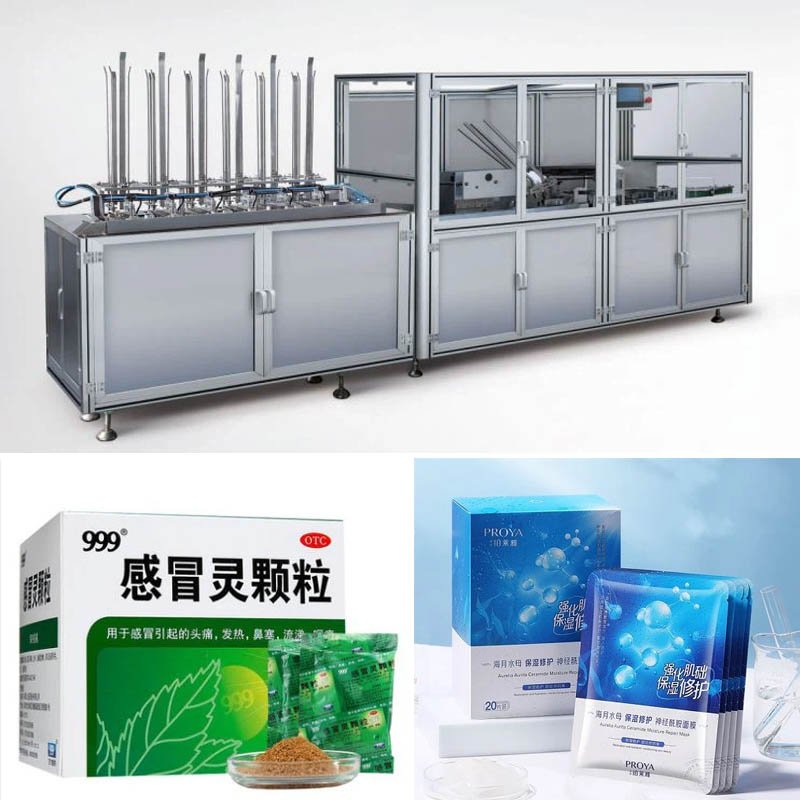
Automatic multi-purpose cartoning machine by HIJPACK with sample pharmaceutical medicine bottles, supplement boxes, and cosmetic hyaluronic acid skincare carton packaging.
HIJPACK versatile automatic cartoning system designed for secondary packaging efficiency across pharmaceutical, nutraceutical, and cosmetic industries.

Chinese vs European Cartoning Machines: The B2B Buyer’s Comparison

Quick Answer For production speeds of 10–200 cartons per minute — where most pharmaceutical, food and cosmetic plants operate —…
Read Article ->
Automatic multi-purpose cartoning machine by HIJPACK with sample pharmaceutical medicine bottles, supplement boxes, and cosmetic hyaluronic acid skincare carton packaging.
HIJPACK versatile automatic cartoning system designed for secondary packaging efficiency across pharmaceutical, nutraceutical, and cosmetic industries.

8 Best Cartoning Machine Manufacturers in 2026 (Honest Comparison)

Quick Answer The leading cartoning machine manufacturers fall into two camps. European premium builders — Marchesini Group and IMA (Italy),…
Read Article ->

How to Choose a Cartoning Machine: The 7-Step Buyer’s Framework

Quick Answer To choose a cartoning machine, match seven factors in this order: product format (flat products need a horizontal…
Read Article ->
Fully automatic capsule filling machine model NJP-1200 made of pharmaceutical-grade stainless steel with gelatin capsule close-ups.
Industrial fully automatic capsule filler provides precise high-speed powder and pellet dosing under a compliant sealed safety enclosure.

Chinese vs European Capsule Filling Machines: An Honest Comparison for B2B Buyers

Quick Answer The honest answer: the country of origin is no longer the deciding variable — the individual manufacturer is.…
Read Article ->

Capsule Filling Machine Validation: A Practical DQ/IQ/OQ/PQ Guide for B2B Buyers

Quick Answer Validation of a capsule filling machine is a four-stage qualification executed by the buyer — Design Qualification (DQ),…
Read Article ->

Tamping Pin vs Dosator: Choosing the Right Capsule Dosing System for Your Powder

Quick Answer Tamping pin systems compress powder into the bores of a rotating dosing disc in successive stages, forming a…
Read Article ->

Let's Design Your Production Line

Share your requirements and I'll personally craft a solution that maximizes your efficiency and profitability.